

The Right Angle: How to Position Your Book for Maximum Client Connection
After discovering your book’s topic, you need to frame it in a way that makes your ideal clients think, “This is exactly the approach I need.” That’s where The Right Angle comes in—the strategic perspective that transforms your expertise into an irresistible client magnet.
Your book’s angle is like choosing the right camera lens for a photograph. You might be capturing the same mountain, but a wide-angle lens shows the entire landscape while a zoom lens focuses on specific details. Same subject, completely different impact.
The same principle applies to your business book. Your angle is the guiding viewpoint that defines your reader’s journey, sets clear expectations, and positions your book as THE essential solution for their challenges. Get this foundation right, and your book cuts through marketplace noise to connect directly with your ideal clients.
Why Your Book Angle Determines Success or Failure
Your angle serves as your competitive advantage in a crowded market. Consider the leadership category—thousands of books exist on this topic, yet certain titles dominate because of their distinctive angles.
“Good to Great” by Jim Collins takes the angle of data-driven research into what separates exceptional companies from merely good ones.
“The Hard Thing About Hard Things” by Ben Horowitz uses the angle of brutal, unfiltered truths about leadership challenges that nobody discusses publicly.
Same topic—leadership. Completely different angles. Both became business bestsellers without competing directly because their angles attracted different audiences with distinct needs.
What Your Angle Accomplishes
Strategic positioning: Steers how readers connect with your content from the first page Audience attraction: Draws in prospects with your unique stance and perspective
Sustained engagement: Holds interest by meeting their specific needs and expectations Action motivation: Prompts readers to implement your advice or hire your services
Your angle isn’t just marketing—it’s the foundation that determines whether your expertise resonates with your ideal clients or gets lost among generic alternatives.
The Five Proven Business Book Angles
Here are five powerful angles you can use to frame your expertise. As you review each one, consider which resonates most strongly with your topic and target audience.
Angle #1: The Revolutionary Approach
This angle positions you as someone who spots critical flaws that everyone else overlooks while they focus on surface-level solutions.
How It Works:
- Identify the ignored problem: The issue people dismiss as “just how things are”
- Flip the perspective: Share an insight that reframes their entire thinking
- Present your solution: Offer a practical adjustment that feels both bold and obvious
Example: “The Lean Startup” by Eric Ries
- Problem identified: Traditional business planning wastes resources on untested ideas
- Revolutionary insight: Use rapid experimentation instead of perfect planning—why spend months theorizing when you can learn what works in weeks?
- Solution: Build-Measure-Learn methodology for faster validation
Keys to Success:
- Back claims with solid evidence and data
- Show concrete results, not just theory
- Address why conventional approaches fall short
- Demonstrate your alternative works consistently
Angle #2: The System Reveal
Think of this as sharing your proven recipe—everyone knows the outcome you deliver, but you provide the exact steps to achieve it consistently.
How It Works:
- Start with your tested method: A process refined through real client work, not theory
- Outline it systematically: Clear stages that fit together like a mental roadmap
- Walk through every step: No gaps, as if you’re personally guiding them
Example: “The E-Myth Revisited” by Michael Gerber
- System premise: Turn your business into a franchise-like operation through repeatable processes
- Clear steps: Work ON the business (not just IN it), define specific roles, build systems for everything
- Proven results: Thousands of entrepreneurs have scaled using this methodology
Why It Resonates:
- Readers feel relief at having a clear path forward
- Creates confidence to proceed with proven steps
- Builds anticipation for achievable results
Angle #3: The Hidden Truth
Position yourself as an insider who’s seen behind the scenes, revealing what’s truly driving success or failure in your field.
How It Works:
- Leverage your unique perspective: Practical experience over textbook theories
- Share breakthrough discoveries: Insights that make readers think, “How did I miss that?”
- Offer insider strategies: Approaches that cut through conventional clutter
Example: “The Hard Thing About Hard Things” by Ben Horowitz
- Hidden truth revealed: Leadership’s real challenges aren’t strategy—they’re brutal, unspoken problems like firing executives or surviving near-bankruptcy
- Insider perspective: Drawn from his experience as a tech CEO and venture capitalist
- Practical strategies: How to handle the messy realities no business school teaches
Critical Elements:
- Root insights in real experience, not conspiracy theories
- Focus on what people overlook due to outdated guidance
- Provide actionable strategies based on insider knowledge
Angle #4: The Transformation Promise
This angle paints a change so vivid that readers can feel the transformation while reading your book.
How It Works:
- Identify the gap: Where they’re stuck versus where they could thrive
- Connect practical to personal: Show how business gains create life improvements
- Provide realistic timeline: Clear checkpoints with achievable milestones
Example: “Essentialism” by Greg McKeown
- The gap identified: From scattered, overcommitted life to focused, meaningful existence
- Transformation promised: Control your time, excel at what matters, feel genuinely calm
- Vivid outcome: Projects finish on time, you’re present with family, colleagues seek your insight
Balance Requirements:
- Make it inspiring yet achievable
- Provide specific timelines you can support with evidence
- Connect business outcomes to personal fulfillment
Angle #5: The Authority Position
Position yourself as an experienced mentor sharing seasoned wisdom from a deep reservoir of knowledge and proven results.
How It Works:
- Demonstrate experience: Show rather than declare your expertise
- Share layered insights: Go beyond surface tips to deeper principles
- Guide with confidence: Calm, clear direction without arrogance
Example: “Good to Great” by Jim Collins
- Experience demonstrated: Five-year study of 1,435 companies with rigorous methodology
- Insights revealed: Level 5 Leadership, Hedgehog Concept, disciplined culture principles
- Guiding approach: “Here’s what the data shows, try it and adapt to your situation”
Success Factors:
- Blend confidence with relatability and humility
- Acknowledge your own learning journey and mistakes
- Let results speak rather than credentials alone
How to Choose Your Right Angle
Selecting your angle isn’t about personal preference—it’s about strategic alignment between your strengths, audience needs, and available evidence.
Three Critical Assessment Factors
- Your Foundation Strength
- Years of experience and documented successes: Authority Position or System Reveal
- Emerging expertise with strong early results: Revolutionary Approach or Hidden Truth
- Personal transformation story: Transformation Promise
- Market Readiness
- Audience aware of problems, ready for change: Revolutionary Approach
- Seeking proven methodologies: System Reveal
- Looking for insider insights: Hidden Truth
- Wanting personal transformation: Transformation Promise
- Respecting experience and wisdom: Authority Position
- Evidence Availability
- Strong case studies and ROI data: System Reveal
- Contrarian insights and surprising results: Revolutionary Approach or Hidden Truth
- Personal transformation stories: Transformation Promise
- Extensive track record and industry recognition: Authority Position
Angle Combination Strategy
You don’t have to limit yourself to one angle. Some of the most powerful business books blend complementary approaches:
Authority + System Reveal: “I’ve been there, here’s my proven method” Revolutionary + Transformation Promise: “Challenge the norm and transform your results” Hidden Truth + System Reveal: “Here’s what insiders know, and how to apply it”
The key is ensuring your chosen angles work together coherently rather than confusing readers with mixed messages.
Strategic Angle Development Process
Step 1: Assess Your Position
Rate yourself on a 1-5 scale for:
- Industry experience and recognition
- Documented client results and case studies
- Unique insights that challenge conventional wisdom
- Personal transformation story
- Proven methodology or system
Step 2: Analyze Your Market
Evaluate your ideal clients’:
- Awareness of the problems you solve
- Openness to new approaches
- Preference for proven systems versus innovative insights
- Respect for experience versus hunger for fresh perspectives
Step 3: Inventory Your Evidence
Document what you have available:
- Client success stories and measurable results
- Data that supports or contradicts industry norms
- Your methodology evolution and refinement process
- Industry recognition and peer validation
- Personal journey and transformation examples
Step 4: Choose and Commit
Select the angle that best aligns across all three factors. Don’t chase your ideal vision if you can’t support it with evidence. The most authentic stories from your actual experience will always resonate most powerfully with readers.
Common Angle Selection Mistakes
The Ego Trap: Choosing an angle that makes you sound impressive rather than helpful The Trend Trap: Following what’s popular instead of what fits your experience The Complexity Trap: Trying to blend too many angles and confusing your message The Evidence Trap: Selecting an angle you can’t support with concrete proof
Your Angle Action Plan
Your angle isn’t just about being different—it’s about being the perfect fit for your ideal clients’ specific needs and mindset. When you align your unique perspective with their urgent problems and readiness for solutions, your book becomes magnetic.
Take time to honestly assess your foundation, understand your market, and choose the angle you can support with compelling evidence. This strategic decision will determine whether your expertise cuts through the noise or gets lost in the crowd.
Remember: thousands of books exist on every business topic, but only one book combines your specific angle, experience, and insights. That’s the book your ideal clients are waiting for—and the one that will position you as their go-to expert.
For Experts, Coaches & Entrepreneurs
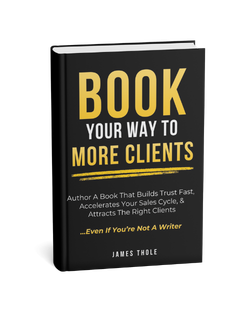
Book Your Way to More Clients
The complete system for writing, publishing, and turning a book into your best client-generating tool. Get your digital copy plus 6 free bonuses for just $7.
Get the Book for $7 →Instant access · 6 free bonuses · 100% money-back guarantee
Ready to write your business book?
Learn how business book ghostwriting works, explore book coaching, or book a quick call to talk through your idea.