
The 5 Foundations Every Business Book Needs (Most Authors Skip These)
What separates business books that attract premium clients from the thousands that disappear into digital obscurity? It’s not writing quality—it’s whether the author built the right strategic foundation before writing a single word.
Over 4 million books are published annually, with thousands of new business titles launching every month. Yet most business books fail to generate any meaningful client attraction or business growth. The difference between success and failure isn’t talent or writing ability—it’s whether authors establish the five critical foundations that transform expertise into client-attracting assets.
As one of fewer than 100 certified ghostwriters worldwide, I’ve seen brilliant experts write books that nobody reads, while others with less experience dominate their industries. Here’s the strategic framework that determines whether your book becomes a client magnet or just another forgotten Amazon listing.
Why Most Business Books Fail Before They’re Even Written
The brutal truth about business book publishing: most authors approach their project with a “write and hope” strategy that virtually guarantees failure.
Common Fatal Assumptions:
- “I’ll write about what I know and hope people find it”
- “Good content will naturally attract readers”
- “My expertise speaks for itself”
- “Writing quality matters more than positioning”
What Actually Happens:
- Books get buried among similar titles with identical positioning
- Ideal clients can’t differentiate your expertise from competitors
- Messages are too broad to resonate with specific audiences
- Readers finish the book but never consider hiring the author
The problem isn’t writing quality—it’s the missing foundational strategy that separates client-attracting books from digital shelf decorations.
Foundation #1: The Right Topic – Laser-Focused Problem Solving
The first foundation determines whether your book finds its intended audience or gets lost in an ocean of generic content.
What Most Authors Get Wrong
Generic Topics That Guarantee Failure:
- “Business Growth Strategies”
- “Leadership Excellence”
- “Digital Marketing Success”
- “Entrepreneurial Mindset”
These broad topics are death sentences for business books. They’re too competitive, too generic, and too unfocused to attract specific ideal clients.
The Right Topic Formula
THE RIGHT TOPIC targets a specific business audience with a clear, urgent problem.
Instead of writing about general business growth, focus on helping $5M+ manufacturing companies scale without losing quality control. Rather than generic leadership advice, address how mid-level tech managers can eliminate burnout while increasing team productivity.
How to Discover Your Right Topic
Analyze your client success patterns:
- Review your last 10-15 successful client projects
- Identify the underlying problems you consistently solve
- Look for patterns across your most successful engagements
- Find the challenge only you address with your unique approach
Example: An M&A adviser could write “How to Sell Your Business” (generic) or “How $5M+ Business Owners Can Maximize Exit Value in 90 Days” (specific). The specificity transforms a commodity topic into a client magnet.
Foundation #2: The Right Angle – Your Strategic Differentiation
Even with the right topic, you need a unique angle that cuts through industry noise and positions your expertise distinctively.
The Five Proven Business Book Angles
- The Revolutionary Approach: “Everyone’s doing X, but Y actually works”
- Challenges conventional wisdom with proven alternatives
- Requires strong evidence and case studies to support claims
- The System Reveal: “Here’s my proven step-by-step method”
- Shares your proprietary process or framework
- Appeals to readers wanting clear, actionable guidance
- The Hidden Truth: “What industry insiders know but won’t tell you”
- Reveals behind-the-scenes insights from your experience
- Creates curiosity while positioning you as the insider expert
- The Transformation Promise: “From where you are to where you want to be”
- Focuses on the reader’s journey and desired outcomes
- Emphasizes the change your expertise enables
- The Authority Position: “Wisdom from someone who’s been there”
- Leverages your experience and proven track record
- Appeals to readers seeking guidance from established experts
Angle Selection Strategy
Your chosen angle determines:
- How readers perceive your expertise level
- Whether you stand out from competitors
- What evidence you need to support your claims
- How you’ll structure your entire book
Example: Instead of “Estate Planning Made Simple” (generic), position with authority: “What I Learned Protecting $2B in Client Assets: Estate Strategies for High-Net-Worth Families.”
Foundation #3: The Right Promise – Your Transformation Commitment
Your promise is the central commitment that defines the reader’s journey and sets clear expectations for the value they’ll receive.
The Promise Formula That Works
Structure: “This book shows [who] how to [what] in [when] through [how], even if [obstacle].”
Weak vs. Strong Promise Examples
Vague Promises That Fail:
- “Improve your business performance”
- “Become a more effective leader”
- “Increase your company revenue”
Specific Promises That Convert:
- “This book shows service business owners how to work less and earn more in 30 days through a streamlined framework, even if they’re currently swamped with details”
- “Mid-level managers learn to eliminate burnout and lead with influence in 90 days through a proven system, even if they’re overwhelmed”
What Your Promise Accomplishes
Strategic Functions:
- Serves as your book’s north star for content decisions
- Becomes your primary marketing message
- Sets clear reader expectations
- Creates your delivery commitment
- Answers the crucial “Why should I read this?” question
Foundation #4: The Right Title – Your First Client Pitch
Your title has approximately three seconds to capture your ideal client’s attention in a crowded marketplace.
Title Elements That Attract Business Clients
Clarity Over Cleverness: Professionals want value they can understand instantly, not puzzles to solve.
Credibility Cues: Use language that signals you operate at their professional level.
Transformation Hint: Suggest meaningful change without making unrealistic promises.
Title Examples That Work vs. Fail
Weak Titles:
- “Business Success Strategies” (too generic)
- “The Leadership Guide” (no differentiation)
- “Growing Your Company” (overcrowded topic)
Strong Titles:
- “Exit Ready: Your Path to a Profitable Goodbye” (specific outcome)
- “The Seven-Figure Law Firm” (concrete aspiration)
- “Never Chase Clients Again” (addresses specific pain)
The Power of Strategic Subtitles
Your subtitle often reflects your book’s promise and does the heavy lifting for client attraction. If readers understand why they should read your book from the cover alone, engagement dramatically increases.
Example: “Write the Right Book for Your Business: How to Write and Publish a Book That Attracts the Right Clients, Streamlines Your Marketing, and Cements Your Authority in Your Niche”
Foundation #5: The Right Structure – Your Client Attraction Blueprint
Most business books follow academic or memoir structures that don’t guide readers toward hiring the author. THE RIGHT STRUCTURE strategically moves readers from problem recognition to solution implementation.
The Proven Client-Attracting Structure
Introduction: Hook readers, paint the vision, establish your credibility as their guide
Chapter 1 – Origin Story: Build trust by sharing your authentic journey to expertise
Chapter 2 – What’s In It for Them: Outline specific, tangible benefits they’ll gain
Chapter 3 – Bust Barriers & Beliefs: Address their doubts and skepticism with proof
Chapter 4 – Every Step, No Steps Skipped: Present your complete system or framework
Chapter 5 – Quick Wins & Tactics: Provide fast results that build confidence and momentum
Chapter 6 – Last Doubts Down: Handle final objections and edge cases
Bridge Chapters: Additional value beyond your core system (1-4 chapters as needed)
Second-to-Last Chapter – Should We Work Together: Clear invitation to hire you
Final Chapter – Big Send-Off: Inspire readers to take immediate action
The Psychology Behind the Structure
Each chapter serves a specific purpose:
- Build trust before teaching your methods
- Address skepticism before presenting solutions
- Provide substantial value before making any requests
- Handle objections before extending invitations
- Guide readers naturally toward collaboration
Why These Foundations Are Non-Negotiable
Skipping any of these foundations creates expensive consequences:
Without the Right Topic: Your book disappears among millions of similar titles Without the Right Angle: You sound identical to every competitor Without the Right Promise: Readers don’t understand what they’re getting Without the Right Title: Ideal clients never pick up your book Without the Right Structure: Readers don’t hire you despite loving your content
The Compound Effect of Getting All Five Right
When all five foundations align strategically:
- Your book cuts through marketplace noise
- Ideal clients immediately recognize it’s for them
- You’re positioned as THE authority in your niche
- Readers naturally progress toward hiring you
- Your expertise becomes a scalable business asset
Your Strategic Foundation Checklist
Before writing a single word, ensure you can clearly articulate:
- Your Specific Topic: What exact problem do you solve for which specific audience?
- Your Unique Angle: How does your perspective differentiate from competitors?
- Your Clear Promise: What transformation will readers experience?
- Your Compelling Title: Does it instantly communicate value to your ideal clients?
- Your Strategic Structure: Does each chapter move readers closer to hiring you?
Start with Strategy, Not Sentences
Most writing advice focuses on craft rather than strategy. Publishing houses prioritize mass appeal over client attraction. But you’re not writing for the masses—you’re writing for your ideal clients.
These five foundations aren’t optional extras—they’re the difference between a book that generates business growth and one that wastes months of effort. Don’t hope your book will somehow find its audience. Build THE RIGHT book from the ground up, and make your time and investment count.
The authors who skip these foundations join the millions of forgotten titles. Those who master them create assets that attract premium clients for years. The choice—and the foundation—is yours.
For Experts, Coaches & Entrepreneurs
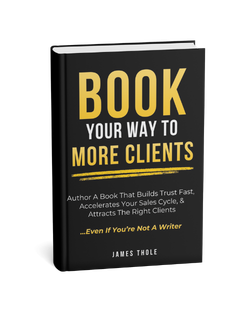
Book Your Way to More Clients
The complete system for writing, publishing, and turning a book into your best client-generating tool. Get your digital copy plus 6 free bonuses for just $7.
Get the Book for $7 →Instant access · 6 free bonuses · 100% money-back guarantee
Ready to write your business book?
Learn how business book ghostwriting works, explore book coaching, or book a quick call to talk through your idea.